|
Chapter 4 - Review of Performance on Noise Policy
Introduction
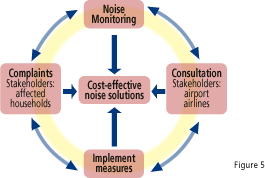
CAD adopts a balanced approach on resolving the conflicts of interests among stakeholders (Figure 5), such that the society may address noise problems in a cost effective manner.
Our other efforts on noise include monitoring aviation technology development with a view to introducing new technology on aircraft noise reduction and disseminating relevant noise data.
 Use Flight paths over water to mitigate aircraft noise impact Use Flight paths over water to mitigate aircraft noise impact
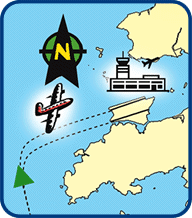
Night Arrival from the Southwest over Water and Night Departure via West Lamma Channel
Given favourable weather and safe flight conditions, aircraft could arrive at the Hong Kong International Airport over water from the southwest and depart over water via the West Lamma Channel during the overnight period.
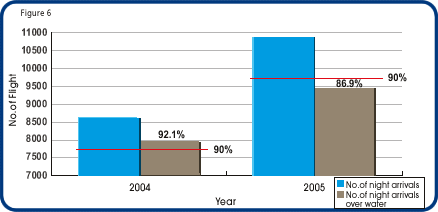
Our targets were to have 90% of aircraft arriving between midnight and 7:00 a.m. to land from southwest over water.
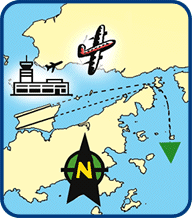
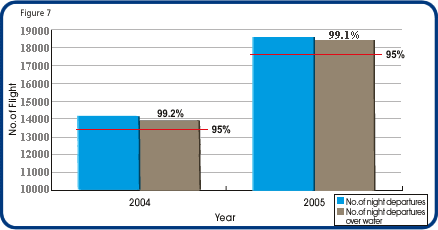
Another target was to have 95% of aircraft taking off between 11:00 p.m. and 7:00 a.m. to depart via West Lamma Channel.
The above two arrangements ensured that populated areas like Sha Tin, Tsuen Wan, Kwai Chung, Sham Tseng and Tsing Lung Tau would not be affected by noise from arriving aircraft and districts like Hung Hom, West Kowloon, North Point, Shau Kei Wan and Chai Wan would not be affected by the noise from departing aircraft.
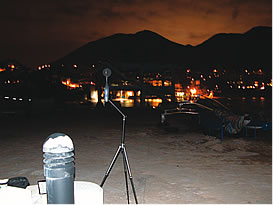
Targets for 2005 and 2006
In 2005, our records indicated that we could only arrange 86.9% of night arrivals to land from southwest over water (Figure 6). However, 99.1% of night departures conducted over water, exceeding the target (Figure 7). In 2006, we would retain these targets.
Quieter Arrival
Given favourable weather and flight conditions, from 11:00pm to 7:00am, aircraft approaching from the northeast could adopt the Continuous Descent Approach (CDA) procedure. The aircraft would fly higher and in a lower power and drag configuration during the commencement of the approach. As a result, those aircraft should be quieter to areas such as Sai Kung, Tseung Kwan O and Ma On Shan.
Targets for 2005 and 2006
In 2005, 75% of aircraft on approach to the Hong Kong International Airport from the northeast from 11:00pm to 7:00am were able to adopt such procedure. In 2006, we would continue to facilitate airlines to conduct CDA procedure.
Quieter Departure
Aircraft departing to the northeast should adopt the noise abatement departure procedures (NADP) prescribed by the International Civil Aviation Organization1 (ICAO) if safe flight operations permit.
Our efforts began in August 1999 when we first implemented ICAO's older version of NADP. In 2001, the ICAO revised those NADP such that aircraft could commence engine power reduction as low as 800 ft. during the initial phase of take off, which was lower than the start point in the former procedures. In March 2002, we implemented these new procedures by which aircraft departing to the northeast should be quieter.
Target for 2006
Airlines are to continue to adopt the NADP for departures to the northeast of the airport.
Ban Noisy Aircraft from Operating in Hong Kong
To comply with an ICAO requirement, we have banned noisy "Chapter 2" aircraft2 from using the Hong Kong International Airport since 1 July 2002. At present, only newer and quieter "Chapter 3" aircraft3 are allowed to use our airport. The banning of "Chapter 2" aircraft should reduce the overall noise in the vicinity of flight paths.
Target for 2006
We will keep on prohibiting "Chapter 2" aircraft from using the Hong Kong International Airport.
Note:
|
| 1 |
ICAO is a United Nation organization established under the Chicago Convention on International Civil Aviation in November of 1944 for developing the principles and techniques of international air navigation and for fostering the planning and development of international air transport.
|
| 2 |
"Chapter 2" aircraft refer to those aircraft which only meet the standards of noise specified in Volume I, Part II, Chapter 2 of Annex 16 to the Convention on International Civil Aviation.
|
| 3 |
"Chapter 3" aircraft refer to those aircraft which meet the standards of noise specified in Volume I, Part II, Chapter 3 of Annex 16 to the Convention on International Civil Aviation.
|
Information to the Public
Maintain Complaint Hotline
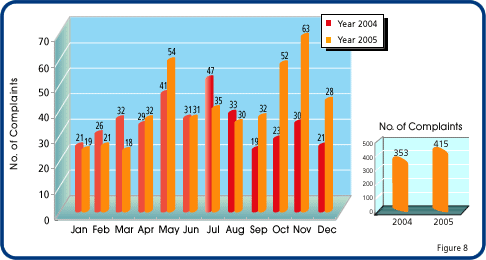
In 2005, we have handled 415 aircraft noise complaints (Figure 8), which is 18% more than the 353 complaints in 2004. Higher complaint figure in 2005 was primarily due to the significant increase of air traffic in 2005.
Information to Legislative Council, District Councils and Local Residents
During 2005, we attended a total of four meetings of the Tsuen Wan District Council, the Kwai Tsing District Council, the Central & Western District Council and the Islands District Council. During the meetings, we explained the noise impacts and the mitigating measures we had implemented. In addition, we have exchanged views on noise issues during a meeting with a member of the Legislative Council, several members of the Tsuen Wan District Council and Tsuen Wan residents.
Publish Noise Data in CAD Website
To facilitate the public to access aircraft noise information, we regularly upload noise data on our website.
Targets for 2005 and 2006
In 2006, we would continue to carry those 2005 targets onboard to provide the community with noise information.
Noise Monitoring
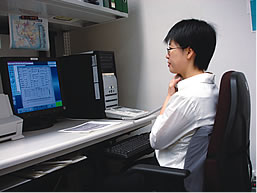
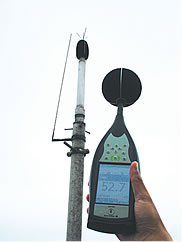
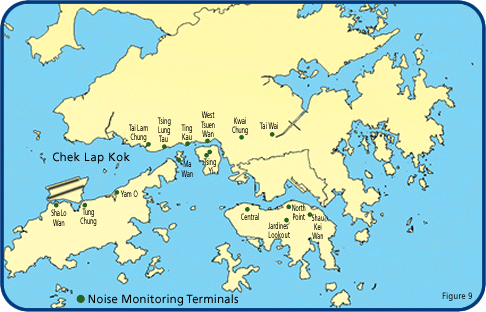
CAD has been monitoring noise in the vicinity of the flight paths with the aid of a computer based aircraft noise and flight track monitoring system (ANFTMS). At present, we have installed 16 fixed noise monitors (Figure 9) to collect noise data in real time.
Our ANFTMS would correlate radar information on flight tracks with noise data from noise monitors. That has allowed us to compile statistics on aircraft noise and investigate into aircraft noise complaints.
Targets for 2005 and 2006
In 2005, we relocated the noise monitor at Tai Wai to improve noise data accuracy. In addition, we have procured one additional monitor as spare unit to reduce the maintenance time for noise monitors. We will keep on reviewing the need for installing new noise monitors or relocating existing ones. In 2006, we will explore the possibility to install an additional noise monitor at Tung Chung East residential district.
|