
Director-General's Review
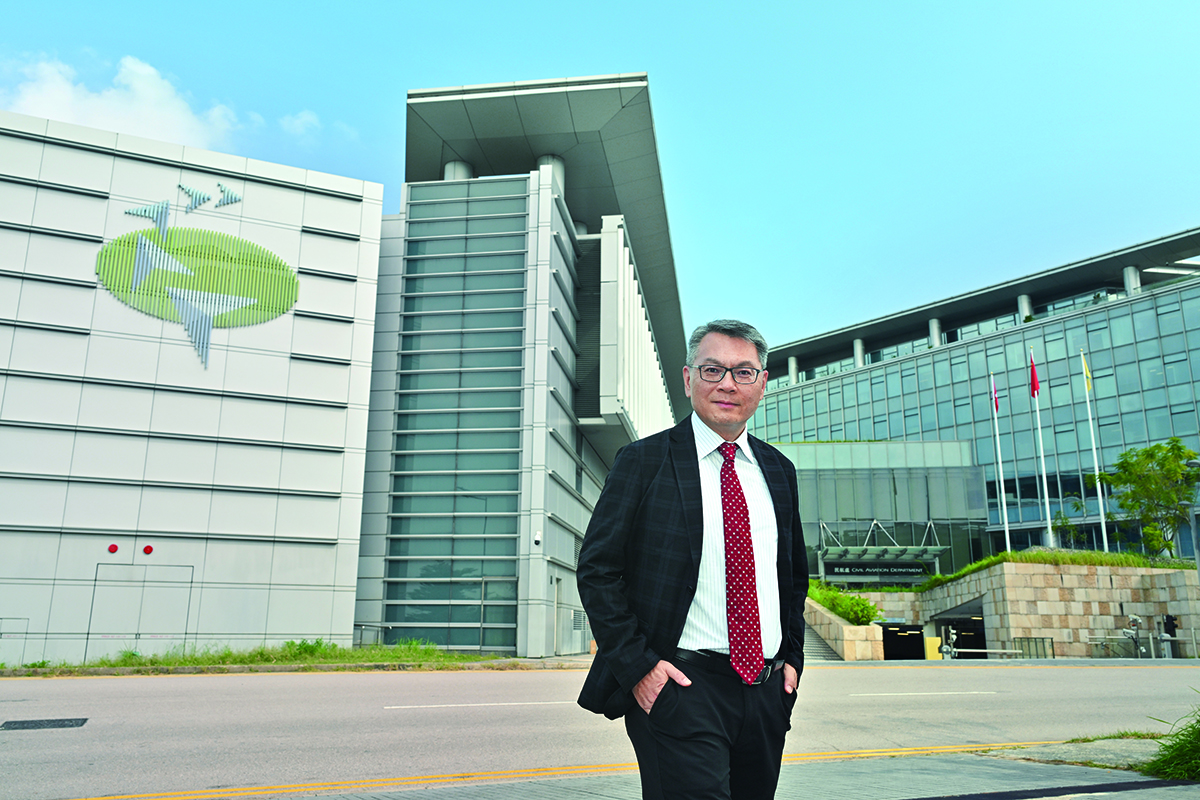
Mr Victor Liu Chi-yung, JP
Director-General of Civil Aviation
2024 set a significant milestone of the Hong Kong aviation industry. The Three-runway System (3RS) at the Hong Kong International Airport (HKIA) was officially commissioned on November 28. Meanwhile, the 102-metre-tall New Air Traffic Control Tower (NAT), equipped with state-of-the-art facilities, successfully transitioned from the Interim Air Traffic Control Tower on November 18 and represented a crucial step towards the full operation of the 3RS.
To facilitate a seamless transition to 3RS operations, the Civil Aviation Department (CAD) set up a dedicated Command Post comprising the CAD's management and support staff. It was tasked with co-ordinating communication and liaison among various divisions of the CAD, the Airport Authority Hong Kong and other stakeholders. Throughout the planning process, the CAD undertook extensive preparatory and regulatory tasks, fully demonstrating the unity, dedication and professionalism of our colleagues in supporting the smooth operations of the 3RS.
As Hong Kong fully returned to normalcy after the pandemic, air traffic figures saw a significant rebound. During the year, the HKIA recorded a passenger throughput of 54.81 million and aircraft movements of 372 928, representing year-on-year increases of about 22% and 20% respectively. On the cargo front, global demand remained robust, with Hong Kong's air cargo throughput reaching 4.94 million tonnes, i.e. a 10% year-on-year increase. The HKIA retained its position as the world's busiest cargo airport for the 14th consecutive year.
With the commissioning of the NAT, the HKIA's capability to keep pace with the growing air traffic has been reinforced. As the 3RS comes into full operation, the CAD will continue to progressively enhance the runway capacity in response to air traffic demand, with a view to increasing the maximum capacity from 69 aircraft movements per hour prior to the system's commissioning to a long-term goal of 102 aircraft movements per hour.
The HKSAR Government attaches great importance to the development of low-altitude economy (LAE) and is adopting a multi-pronged strategy to build a smart LAE ecosystem. A prerequisite for developing LAE is to ensure the safe operation of low-altitude flying activities. To support the development, the CAD introduced legislative amendments to the Small Unmanned Aircraft Order (Cap. 448G) and the Air Navigation (Hong Kong) Order 1995 (Cap. 448C) during the year. The amendments proposed the introduction of a new category of unmanned aircraft weighing more than 25 kilograms but not exceeding 150 kilograms along with specific requirements to be met, and new provisions to facilitate the trial operations of the various types of unconventional aircraft in Hong Kong. Industry consultation on the proposed amendments was completed in March 2025 and stakeholders generally expressed their support.
In addition, since 2025, the Government has been testing various low-altitude flying application scenarios, technical and site requirements, and cross-departmental regulatory co-ordination through the LAE Regulatory Sandbox pilot projects. The aims are to gather data and accumulate experience for guiding the work on multiple fronts, including regulations, infrastructure and applications.
The CAD has been actively strengthening its collaboration with the Mainland in civil aviation. In late 2024, the Civil Aviation Administration of China (CAAC), the CAD and the Civil Aviation Authority of the Macao Special Administrative Region signed a Co-operation Arrangement on Joint Operation Management and an Amendment to the Memorandum of Understanding on Closer Co-operation on Airworthiness Certification to expand the co-operation in operational and airworthiness certification among the three parties, and further promote aviation safety and operational efficiency in the three places. This initiative not only promotes the development of the aviation industry in the Guangdong-Hong Kong-Macao Greater Bay Area (GBA), but also helps Hong Kong seize the important opportunities brought by the National 14th Five-Year Plan to consolidate its status as an international aviation hub.
Hong Kong fully supports the development of the country's aircraft manufacturing industry and leverages its edge as an international aviation hub to allow more travellers to learn about the extraordinary achievements of the country's aviation development. Starting from January 1, 2025, China Eastern Airlines operates a scheduled daily round-trip flight between Shanghai Hongqiao and Hong Kong using the home-developed C919 aircraft. Passengers can now experience first-hand the exceptional achievements of China's aviation manufacturing industry by taking the C919 aircraft to travel from the HKIA to the Mainland.
Our country's civil aviation technology is undergoing rapid advancement. To help the public better understand the civil aviation development of our country, the CAD set up new exhibition galleries at the Aviation Education Path in early 2025, featuring themes on "Uprising of the Two Airlines" and the civil aviation development of China, enriching the path with greater diversity.
The CAD has been taking an active role in nurturing talents for Hong Kong's aviation industry. On October 5, 2024, the CAD held an aviation-themed youth activity at its Headquarters to celebrate the 75th Anniversary of the founding of the People's Republic of China and enhance young people's understanding of the aviation development in Hong Kong. In the same year, the CAD organised the GBA Civil Aviation Youth Exchange Program under the theme of "GBA Quest for Dreams, Youthful Companionship Lights the Path" jointly with the Central and Southern Regional Administration of the CAAC. The Program is designed to furnish young aviation practitioners from the GBA with a platform to acquire an in-depth understanding of the aviation industry in the Mainland and Hong Kong, as well as to enhance the exchange of talent and promote high-quality and synergistic development of civil aviation in the GBA.
The year 2025 marks the centenary of Hong Kong's airport development. The former Kai Tak Airport not only carried countless precious memories and historical moments, but also bore witness to the glorious legend of Hong Kong's aviation industry. It demonstrated how Hong Kong achieved a remarkable operational capacity despite space constraints, laying a solid foundation for the outstanding performance of the HKIA today.
With the full operation of the 3RS, the HKIA will further strengthen its role as a vital gateway connecting the GBA to the rest of the world. The CAD will build on previous developments to open up new horizons in the future. We will work diligently to ensure the smooth and reliable operation of air traffic management systems, equipment and infrastructure, and thus reinforce Hong Kong's position as an international aviation hub. At the same time, we will proactively seize emerging opportunities to elevate Hong Kong's aviation industry to new heights and achieve greater success.